 Emily Jung Miller
Mandarin Orange Peel #1048 Purchase

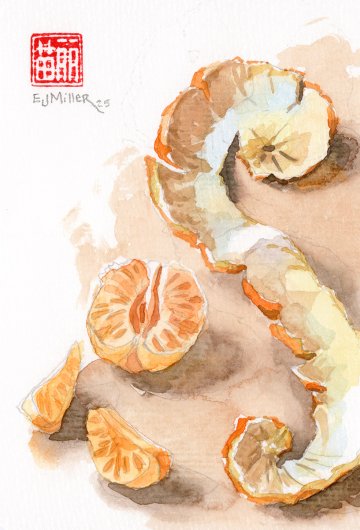
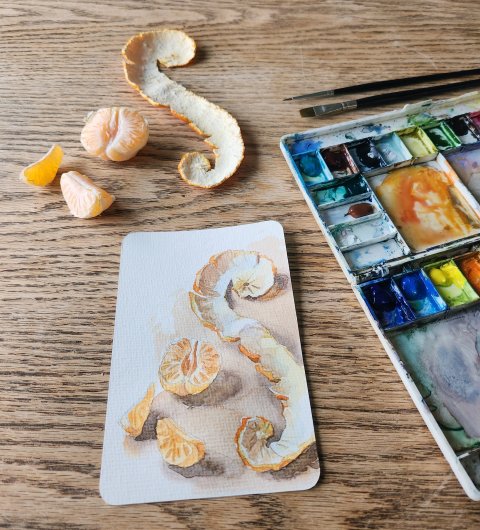
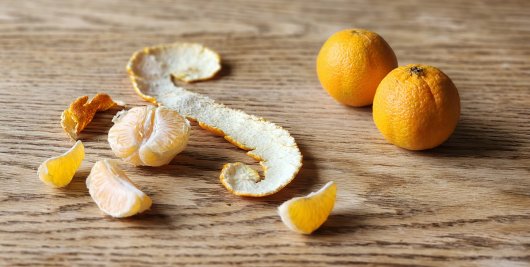
Third in a series of sketches exploring my Hakka Chinese heritage and personal family history through traditional foods and recipes. The small, flattened Mandarin orange is one of the earliest ancestral types of orange. It is the "mother orange" of many other oranges, including tangerines, satsumas, and clementines. Mandarins originate in the Nanling Mountains of southern China and are widely hybridized today. These winter-ripe, brightly colored fruits are traditional in East Asian Lunar New Year celebrations and temple offerings, and in American Christmas stockings since the 1880s, a tradition introduced by Japanese immigrants.
Mandarin oranges are called 橘 jú or 橘子 jú zi in Mandarin Chinese. The use of 子 (zi) as a noun suffix is common in Chinese, often used for fruits, seeds, and small objects (also seen in the choice of using 柿 shì or 柿子 shì zi for persimmon). Adding 子 (zi) specifies the fruit itself, rather than the entire tree 木. The "tree" character 木 is included as the first part of the characters for both Mandarin orange 橘 and persimmon 柿.
Dried Mandarin peels are used in Asian cooking and Traditional Chinese Medicine. The dried peels are called 陈皮 chen pi (literally "preserved peel") or 橘皮 jú pi ("mandarin orange peel").
I grew up eating these little oranges without much connection to these traditions, although I remember knowing it was good luck to have them around during the New Year season. Now, I am saving and drying the peels for the first time, for use in winter recipes.
Here are two options describing the home drying method:
Mandarin oranges are called 橘 jú or 橘子 jú zi in Mandarin Chinese. The use of 子 (zi) as a noun suffix is common in Chinese, often used for fruits, seeds, and small objects (also seen in the choice of using 柿 shì or 柿子 shì zi for persimmon). Adding 子 (zi) specifies the fruit itself, rather than the entire tree 木. The "tree" character 木 is included as the first part of the characters for both Mandarin orange 橘 and persimmon 柿.
Dried Mandarin peels are used in Asian cooking and Traditional Chinese Medicine. The dried peels are called 陈皮 chen pi (literally "preserved peel") or 橘皮 jú pi ("mandarin orange peel").
I grew up eating these little oranges without much connection to these traditions, although I remember knowing it was good luck to have them around during the New Year season. Now, I am saving and drying the peels for the first time, for use in winter recipes.
Here are two options describing the home drying method:
Watercolor, 2025
4" x 6"
Original Painting Unavailable
Purchase Mandarin Orange Peel, Golden Orange Greens Art Prints:
| 5x7" Paper giclee |
$40
|
|
| 8x10" Paper giclee |
$45
|
|
| 11x14" Paper giclee |
$100
|
|
| 16x20" Paper giclee |
$165
|
|
| 12x16" Canvas wrap |
$165
|
|
| 18x24" Canvas wrap |
$250
|
Need a different size? Ask about custom print sizes and formats
Commissions to create new original artwork are currently closed. I will be reviewing my commission schedule for possible openings in January 2027.


