 Emily Jung Miller
Ginger Root #1063 Purchase

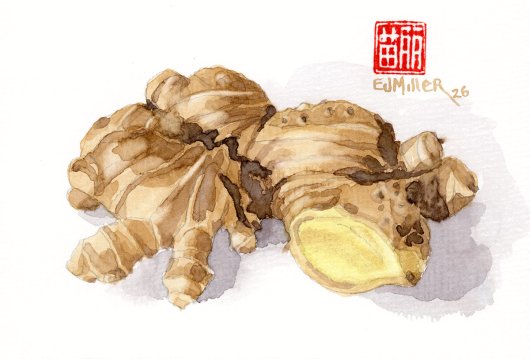
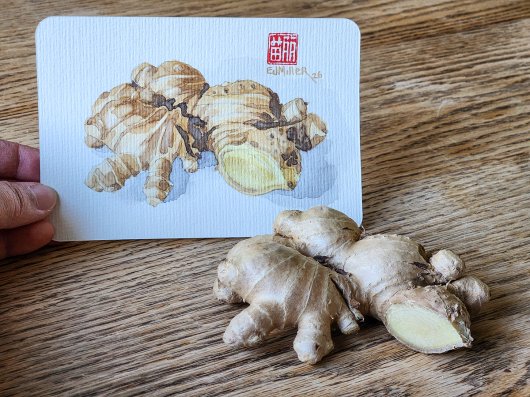
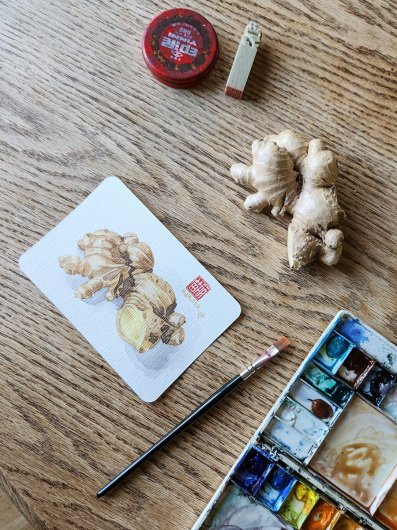
Eighth in a series of monthly sketches exploring my Hakka Chinese heritage and personal family history through traditional, seasonal foods and recipes. I chose ginger root for May, reflective of the freshness of springtime.
Ginger root is a fragrant, year-round staple in Chinese cooking and traditional medicine. Growing up, my Hakka Chinese mother often served simple stir-fries with thick coins of sliced ginger. Biting into them was an eye-opening surprise if I wasn't paying attention to my meal. As a child, my mom's go-to remedy for a tummyache was ginger ale. I've since learned that ginger tea is a traditional Chinese remedy, although tea was not normally served in our family.
As a child and teen, I remember ginger felt "toooo spicy!" As an adult, I now love the spiciness in the strongest ginger ale, and the freshness of ginger flavor in soups, chicken dishes, and stir-fries. Preparing ginger for cooking, I always feel deeply connected to memories of my mom as I repeat the same actions in the kitchen, using her big knife to shave the dry skin off the ginger root, trimming carefully around all the little knobs, then slicing the sparkling peeled root into golden coins and mincing into matchsticks. In this painting, I used metallic golden watercolor to add sparkle to the cut end of the ginger root.
In Chinese, the character for ginger can be either 薑 (traditional) or 姜 (simplified). It is pronounced jiāng in Mandarin and gēung in Cantonese. Fresh ginger root is 生姜 (shēng jiāng or saang gēung). The traditional character 薑 contains the characters for "flower, grass, or plant" and "barbed wire," which feels like an accurate description of my childhood memories biting into fresh raw ginger!
Ginger features in a popular Chinese saying 姜还是老的辣 (jiāng háishi lǎo de là) that translates to "The older the ginger, the spicier it is" - in praise of the experience, skill, (and spiciness!) of our elders. The first written mention of ginger comes from the Analects, written by disciples of Confucius during the Warring States period (475–221 BCE), where Confucius is said to have eaten ginger with every meal. The plant originated in Southeast Asia and was spread across the Pacific as a canoe plant more than 5,000 years ago.
Three of my favorite ginger recipes:
Ginger root is a fragrant, year-round staple in Chinese cooking and traditional medicine. Growing up, my Hakka Chinese mother often served simple stir-fries with thick coins of sliced ginger. Biting into them was an eye-opening surprise if I wasn't paying attention to my meal. As a child, my mom's go-to remedy for a tummyache was ginger ale. I've since learned that ginger tea is a traditional Chinese remedy, although tea was not normally served in our family.
As a child and teen, I remember ginger felt "toooo spicy!" As an adult, I now love the spiciness in the strongest ginger ale, and the freshness of ginger flavor in soups, chicken dishes, and stir-fries. Preparing ginger for cooking, I always feel deeply connected to memories of my mom as I repeat the same actions in the kitchen, using her big knife to shave the dry skin off the ginger root, trimming carefully around all the little knobs, then slicing the sparkling peeled root into golden coins and mincing into matchsticks. In this painting, I used metallic golden watercolor to add sparkle to the cut end of the ginger root.
In Chinese, the character for ginger can be either 薑 (traditional) or 姜 (simplified). It is pronounced jiāng in Mandarin and gēung in Cantonese. Fresh ginger root is 生姜 (shēng jiāng or saang gēung). The traditional character 薑 contains the characters for "flower, grass, or plant" and "barbed wire," which feels like an accurate description of my childhood memories biting into fresh raw ginger!
Ginger features in a popular Chinese saying 姜还是老的辣 (jiāng háishi lǎo de là) that translates to "The older the ginger, the spicier it is" - in praise of the experience, skill, (and spiciness!) of our elders. The first written mention of ginger comes from the Analects, written by disciples of Confucius during the Warring States period (475–221 BCE), where Confucius is said to have eaten ginger with every meal. The plant originated in Southeast Asia and was spread across the Pacific as a canoe plant more than 5,000 years ago.
Three of my favorite ginger recipes:
- Shoyu Ginger Chicken
a copycat recipe I developed inspired by Hanalei Mixed Plate on Kauai
- Green Pea Soup with Ginger
a flexible recipe I adapted from The Essential Vegetarian Cookbook p. 41, a gift from my mom years ago
- Chicken and Goji Berry Soup
a new favorite from The Hakka Cookbook p. 176 (strongest flavor notes of Cilantro and Ginger)
Watercolor, 2026
4" x 6"
Original Painting Unavailable
Purchase Ginger Root, Golden Orange Greens Art Prints:
| 5x7" Paper giclee |
$40
|
|
| 8x10" Paper giclee |
$45
|
|
| 11x14" Paper giclee |
$100
|
|
| 16x20" Paper giclee |
$165
|
|
| 12x16" Canvas wrap |
$165
|
|
| 18x24" Canvas wrap |
$250
|
Need a different size? Ask about custom print sizes and formats
Orders placed August 24 - Sept. 6, 2026 will be fulfilled starting on Sept. 8, 2026.


