 Emily Jung Miller
Cilantro #1053 Purchase

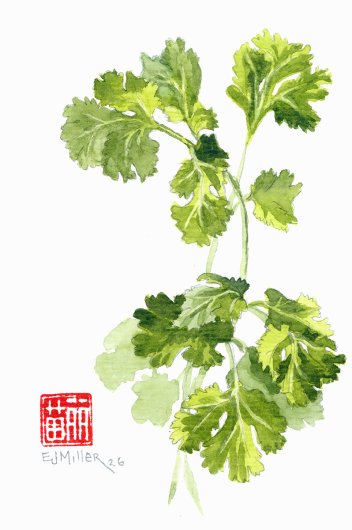


Sixth in a series of monthly sketches exploring my Hakka Chinese heritage and personal family history through traditional foods and recipes. I have been painting this series at my kitchen table, near the windows looking out to the backyard.
Cilantro is xiāngcài 香菜 in Mandarin Chinese, and yoon sai 芫茜 in Cantonese. I feel fortunate to enjoy the taste of cilantro, and I remember my Hakka grandmother growing it in her backyard garden. I can't remember the first time I ate cilantro, as it has been a lifelong familiar companion.
I painted this in March, in celebration of springtime. Afterwards, I realized the painting also carries hints of St. Patrick's Day shamrocks for me. I enjoyed using my cilantro in my first attempt at Chicken and Goji Berry Soup from The Hakka Cookbook. It feels like a perfect spring soup for warming up on days that are still cold, but bright and fresh with the flavors of ginger and cilantro.
I've also enjoyed learning about the construction of Chinese characters through this project. From contextualchinese.com:
In Cantonese, different characters are used that sound similar, to avoid sounding like Mandarin characters that are inauspicious when pronounced in Cantonese.
Cilantro is xiāngcài 香菜 in Mandarin Chinese, and yoon sai 芫茜 in Cantonese. I feel fortunate to enjoy the taste of cilantro, and I remember my Hakka grandmother growing it in her backyard garden. I can't remember the first time I ate cilantro, as it has been a lifelong familiar companion.
I painted this in March, in celebration of springtime. Afterwards, I realized the painting also carries hints of St. Patrick's Day shamrocks for me. I enjoyed using my cilantro in my first attempt at Chicken and Goji Berry Soup from The Hakka Cookbook. It feels like a perfect spring soup for warming up on days that are still cold, but bright and fresh with the flavors of ginger and cilantro.
I've also enjoyed learning about the construction of Chinese characters through this project. From contextualchinese.com:
- 香 (xiāng): This character means fragrant, aromatic, or scented. It's composed of 禾 (hé), meaning “grain,” and 甘 (gān), meaning “sweet.” Originally, it depicted the sweet, pleasant smell of harvested millet. Today, it's used to describe anything with a nice smell, from perfume (香水) to delicious food.
- 菜 (cài): This character means vegetable, greens, or more broadly, a dish or type of cuisine (e.g., 中国菜 - Chinese food). The top part (艹) is the “grass” radical, indicating it's a type of plant.
- The two characters combine to mean "fragrant vegetable."
In Cantonese, different characters are used that sound similar, to avoid sounding like Mandarin characters that are inauspicious when pronounced in Cantonese.
Watercolor, 2026
4" x 6"
Original Painting Unavailable
Purchase Cilantro, Still Life Art Prints:
| 5x7 matted to 11x14" Art print |
$32
|
|
| 8x10 matted to 11x14" Art print |
$40
|
|
| 11x14" Paper giclee |
$100
|
|
| 16x20" Paper giclee |
$165
|
|
| Set of 8 Greeting Cards + Envelopes |
$30
| |
| Single Greeting Card + Envelope | $4 |
Need a different size? Ask about custom print sizes and formats
Limited spaces are now open for custom painting commissions in 2026! I am accepting commissions for sizes 16x20" and larger.


